
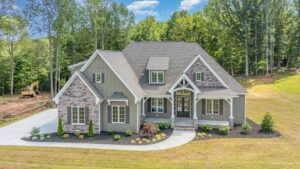
 One of the first choices you’ll need to make when working with one of Greensboro builders is whether you’ll build a one-story or two-story home. Each option has its benefits, but only one will be the right choice for your needs, lot, and long-term plans.
This guide draws on R&K Custom Homes’ experience building luxury custom homes throughout the Greensboro and Triad area to help you make an informed decision about which style best serves your family.
The Pros and Cons of One-Story Homes
There is a lot to like about one-story homes, but they come with a few drawbacks. This list will provide insight into both sides of the equation.
PRO – Complete Accessibility
This is the primary motivation for most people to choose a one-story home. Without stairs separating the levels, it’s easy to get around the entire house for people of all ages. Ramblers are often thought of as being beneficial for older people, but those with young children can appreciate the convenience just as much. You’ll never carry a sleeping toddler up the stairs, never worry about baby gates that never feel quite secure, and never make multiple trips up and down to grab forgotten items.
Beyond age considerations, think about temporary limitations like recovering from surgery, dealing with an injury, or the late stages of pregnancy when stairs feel daunting. One-story living means you can use every room in your home regardless of physical capabilities, now or in the future. If you’re building a home you plan to live in for 20, 30, or 40 years, this matters more than you might think today.
CON – Larger Footprint
You’ll need more land to build a one-story home with the same square footage as a two-story home. The house naturally has to spread out since none of it is stacked up, so you might wind up spending more on the purchase of your land before construction can even begin.
To put this in perspective, a 3,000-square-foot two-story home might have a 1,500-square-foot footprint per floor. That same 3,000-square-foot home as a ranch style needs about 3,000-3,200 square feet of lot coverage when you account for the garage and covered porches. After factoring in required setbacks from property lines (typically 20-30 feet from the front, 10-25 feet from sides, 20-30 feet from the rear in many Greensboro developments), some lots simply can’t accommodate a large one-story home. You’ll also have less yard space left over for pools, gardens, or outdoor living areas.
PRO – Simpler and Safer Maintenance
Without building up so high, many maintenance tasks are made easier. Things like window cleaning and roof access are more approachable when the house is just a single story throughout. You can clean exterior windows from the ground or a short ladder instead of needing scaffolding or professional help. Gutter cleaning, roof inspections, painting trim, and even hanging holiday lights become manageable DIY tasks rather than requiring expensive professional services or risky ladder work.
This advantage compounds over years of homeownership. As you get older, the maintenance tasks that felt easy at 35 feel a lot less appealing at 55 or 65. Ranch-style homes stay manageable.
CON – Higher Foundation and Roof Costs
This one goes back to the point about having a larger footprint. That larger footprint is going to be supported by a bigger foundation, meaning the foundation work will be more extensive. You’re also covering more area with your roof. A 3,000-square-foot one-story home needs roughly twice the foundation and roof area of a 1,500-square-foot-per-floor two-story home. These systems represent significant construction elements that affect overall project scope.
PRO – Better Temperature Control
One-story homes maintain consistent temperatures throughout more easily than two-story homes. Without hot air rising to a second floor that’s always warmer, your HVAC system works more efficiently. You won’t deal with a freezing first floor while the bedrooms upstairs are sweltering, or vice versa. A single zone can heat and cool the entire home effectively without fighting against basic physics. Your utility bills tend to be more predictable, and you won’t constantly fiddle with thermostats trying to balance comfort between floors.
PRO – Open Floor Plans and High Ceilings
Without a second floor above, you have design flexibility that two-story homes can’t match. Want a great room with vaulted ceilings soaring 14, 16, or even 18 feet? No problem. Exposed beams, cathedral ceilings, dramatic height variations between rooms, and skylights become easy to incorporate. The lack of second-floor support requirements means architects can create open, flowing spaces with long sight lines and better natural light throughout.
CON – Less Privacy Between Spaces
With all rooms on a single level, creating separation between the primary bedroom and kids’ rooms, or between sleeping areas and living spaces, requires more thoughtful planning. You’ll hear the TV from bedrooms more easily, kitchen noises reach further, and teenagers have less separation from the main household. Good design can address this with hallways, closets, and smart room placement, but it takes more intentional effort than two-story homes provide naturally.
The Pros and Cons of Two-Story Homes
Many people default to a two-story home when designing a custom house, and there is a lot to like. This list will also touch on the downsides, so you can make an informed decision.
PRO – Separation of Spaces
One of the big things to like about two-story homes is how they break up the various parts of the house. Often, the bedrooms will be upstairs, while the shared living spaces are on the first floor. This is a nice separation and can make daily living more comfortable for everyone.
When you’re hosting a party, the entire first floor becomes entertaining space while bedrooms stay completely private upstairs. When teenagers have friends over, they can hang out on their floor without feeling like they’re under constant supervision. When one spouse is an early riser and the other a night owl, the vertical separation means less disturbance. Home offices on the first floor stay separate from bedroom areas, which matters when you take video calls or meet with clients.
CON – HVAC Challenges
It’s difficult to maintain the same temperature across two different floors of a home. If the first floor is comfortable, the second floor is usually too warm. Or, if the second floor is comfortable, the first floor may feel cold. This isn’t just a minor annoyance. The temperature differential between floors can reach 8-10 degrees or more.
Hot air rises, which means second-floor bedrooms get uncomfortably warm, especially in North Carolina summers. You’ll find yourself adjusting thermostats constantly, or you’ll need a more expensive dual-zone HVAC system with separate controls for each floor. Even with two zones, you’re fighting against physics. One-story homes simply don’t have this problem.
PRO – Efficient Use of Land
Just as a one-story home uses a lot of land, a two-story house can pack a lot of square footage into a relatively small piece of property. This matters tremendously in many Greensboro neighborhoods where available lots are smaller or where you want both a spacious home and substantial outdoor areas.
A two-story home leaves more of your lot available for yards, pools, gardens, or privacy buffers from neighbors. On urban or infill lots where space is at a premium, two-story construction might be your only option for achieving the square footage you want. Even on larger lots, the smaller footprint means less site disturbance and potentially saving more mature trees.
CON – Inconvenient Stairs
Even if you are physically capable of going up and down the stairs, you might find living in a house with stairs to be a bit frustrating. Think about the daily reality. Forgot your phone upstairs? That’s a trip. Need to grab something from the bedroom? Another trip. Doing laundry? Up and down multiple times. With young kids, you’re constantly going up to check on them, help with bedtime, or retrieve them for meals.
The inconvenience adds up to dozens of stair trips daily. If you sprain an ankle, have knee surgery, or deal with any temporary mobility issue, suddenly your own home becomes difficult to navigate.
Also, you might not be able to stay in the home as long if your physical capabilities change in the coming years. Stairs that feel like easy exercise today might become barriers at 70 or 75. Many people end up selling homes they love because stairs become unmanageable, whether from arthritis, balance issues, or just reduced stamina. One-story homes let you age in place without expensive modifications or difficult decisions about selling.
PRO – Better Views and Curb Appeal
Second-floor bedrooms capture views over neighboring homes and landscapes. You get more privacy in upstairs bedrooms since neighbors can’t see in your windows easily. The elevated position is especially valuable on lots with golf course, mountain, or natural area views.
Two-story homes also create more dramatic curb appeal. They command stronger street presence with more interesting elevations, varied rooflines, and architectural details that make custom homes look substantial from the exterior.
PRO – Room Over Garage
Two-story construction lets you position bonus rooms, guest suites, or bedrooms over the garage. This maximizes usable square footage without expanding your foundation and lot coverage. These spaces work great for guest quarters, teen hangouts, home gyms, or media rooms, and they feel naturally separated from the main living areas.
CON – Noise Between Floors
While you get privacy from upstairs bedrooms being separated from living areas, you also get impact noise. Footsteps, furniture moving, kids running around, and things dropping upstairs all transmit sound to the first floor. Even with quality construction and sound insulation, you’ll hear more activity than you would with everything on one level. Plumbing noise from upstairs bathrooms can also reach first-floor rooms.
CON – Harder Maintenance
Exterior painting, window cleaning, and roof work all require scaffolding or tall ladders for two-story homes. Simple tasks that a one-story homeowner handles themselves become jobs requiring professional help or expensive equipment. You’ll pay more for exterior maintenance over the home’s lifetime, and routine upkeep feels more daunting as you age.
How to Decide What’s Right for You
Rather than debating which is better, think about which style fits your specific situation.
Start with Your Lot
Your lot often makes the decision for you. Calculate whether your desired home size actually fits as a one-story after accounting for setbacks. Many neighborhoods with standard lots under half an acre require two-story construction to achieve 3,000+ square feet.
Look at your lot’s topography too. The Triad’s rolling terrain means many desirable lots have slopes. Two-story homes often work better on sloped lots, positioning garages at lower elevations and living spaces above. One-story homes on slopes need extensive grading and retaining walls, which gets expensive.
Think About Your Family’s Stage
Families with young children face a trade-off. One-story homes make supervision easier and eliminate stair safety concerns. Two-story homes give kids their own floor as they get older, which families with teenagers often appreciate.
Empty nesters and couples without kids usually prefer one-story convenience and simpler maintenance. If you’re building your retirement home, one-story makes even more sense.
Consider How Long You’ll Stay
Building a home you’ll live in for 5-10 years? Choose based on current preferences. Planning to stay 20+ years? Think about aging in place. One-story homes provide certainty that you’ll never need to move because of accessibility issues.
Match Your Lifestyle Priorities
If you entertain frequently, two-story separation of public and private spaces works beautifully. If you rarely have guests and prioritize daily convenience, one-story living delivers.
Active families who spend lots of time in yards and outdoor spaces benefit from one-story homes’ easy access to patios and porches from every room. Privacy-focused households appreciate two-story bedroom separation from living areas.
Understand the Greensboro Market
Two-story homes appeal to families with children, which represents the largest buyer group. One-story homes attract empty nesters, retirees, and anyone prioritizing accessibility. Both styles sell well in the luxury custom market when properly designed for their lots and neighborhoods.
Don’t Decide Alone
With years of experience building custom homes throughout the Greensboro and Triad area, R&K Custom Homes has the knowledge and insight necessary to help you choose your new home’s style.
R&K evaluates your specific lot to determine which style works with its dimensions, topography, and neighborhood character. Some lots clearly favor one option while others work equally well with either. Through detailed conversations about your daily life, family composition, and long-term plans, R&K helps you understand which style truly serves your needs rather than abstract preferences.
R&K can create preliminary floor plans for both configurations tailored to your situation, letting you see how each option would actually function for your family. This makes the abstract decision concrete and helps you visualize living in each style.
As experienced home builders in the luxury custom market, R&K has successfully designed and built both one-story and two-story homes throughout the region. Whether you need a sprawling ranch-style estate or an elegant two-story traditional home, R&K maintains the same commitment to quality craftsmanship and attention to detail.
The goal isn’t pushing you toward what’s easier to build. It’s creating a home you’ll love for decades. If a one-story home serves you better, R&K will guide you that way even if it means more complex site work. Your satisfaction matters more than construction convenience.
With R&K on board as your home builders of choice, you’ll have everything you need to bring the project together and create something amazing. Call today to learn more about how R&K Custom Homes can help you make this important decision and design a custom home perfectly suited to your vision, lot, and lifestyle.
Frequently Asked Questions
Which is better for families with young children?
Both work well but differently. One-story homes let you supervise kids more easily throughout the house and eliminate stair safety concerns. Two-story homes give kids their own floor for playing while parents work or relax downstairs. The right choice depends on whether stair convenience or space separation matters more to your family.
How do these styles differ for aging in place?
One-story homes are dramatically better for aging in place. Without stairs, you maintain full home access regardless of mobility changes. Two-story homes may eventually require expensive stair lifts or first-floor suite additions, or force you to sell when stairs become unmanageable. If you plan to stay 20+ years, one-story provides peace of mind.
Which has better resale value?
Both sell well when properly designed for their lots and neighborhoods. Two-story homes appeal to families with children. One-story homes attract empty nesters and retirees. In the luxury custom market, quality and location matter more than whether you have one or two stories.
Can I build a one-story home on a small lot?
It depends on your lot’s buildable area after setbacks. Many neighborhoods with lots under half an acre require two-story construction to achieve larger home sizes. Have R&K analyze your specific lot’s dimensions and setback requirements to determine what fits.
What about HVAC costs?
Two-story homes typically need more complex dual-zone systems to maintain comfort between floors. One-story homes achieve comfortable temperatures with simpler systems. Over decades of ownership, one-story homes generally cost less to heat and cool due to fewer physics challenges.
How does lot slope affect the decision?
Sloped lots generally work better with two-story homes that can position garages lower and living spaces above, following natural topography. One-story homes on slopes need extensive grading and retaining walls. However, some sloped lots work beautifully with one-story designs. Have R&K evaluate your specific lot before deciding.
Which offers more design flexibility?
One-story homes provide vaulted ceilings, exposed beams, and dramatic height variations that two-story homes can’t match. Two-story homes offer dramatic entry foyers, rooms over garages, and more interesting exterior elevations. Both can be designed beautifully with different aesthetic opportunities.
Will stairs become a problem as I age?
Possibly. Stairs that feel easy today might become barriers from arthritis, balance issues, or reduced stamina. Many homeowners eventually sell homes they love because stairs become unmanageable. If you’re building a forever home, consider whether you want that uncertainty.